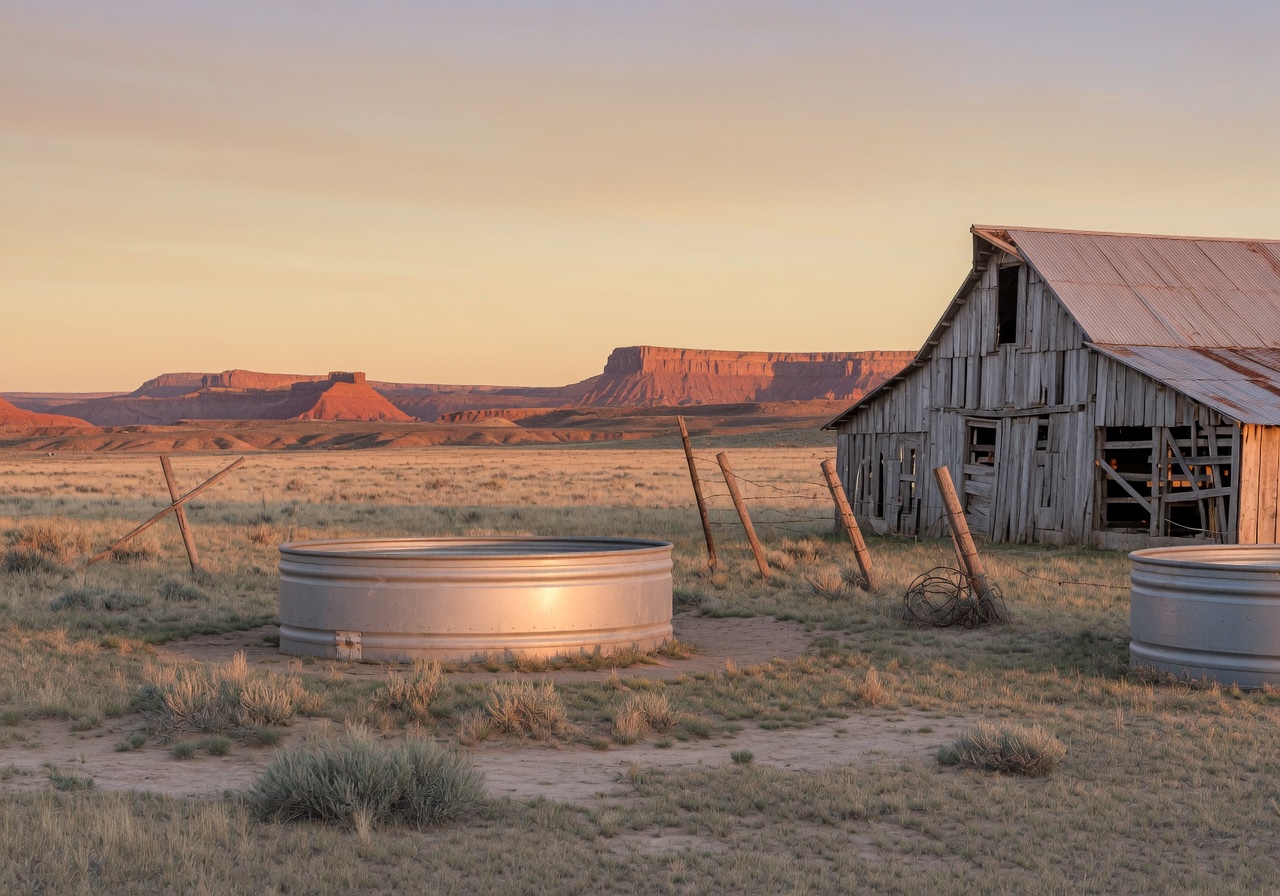
A house has one furnace and one water heater. A working place has a barn, a shop, a well, a stock tank that cannot be allowed to freeze, and usually a generator that nobody thinks about until the power goes out. All of it comes off the same propane supply, and all of it comes on at once when the temperature drops.
That is why a ranch tank runs down faster in a cold week than most people plan for, and why the places furthest out are the hardest for us to reach when the weather turns. Here is what we tell our agricultural customers to do while the roads are still easy.
Know what is pulling on the tank
Out here propane is not just heat. On a typical working place it is running some combination of:
- barn and livestock shed heat, including heat for young stock
- stock tank heaters, which run hard and quietly through every freeze
- water heaters in a shop, a bunkhouse, or a second residence
- a standby generator that starts on its own when the power drops
- irrigation engines and grain drying, depending on the operation
- a forklift or shop equipment
Add a cold snap and several of those run at once. A tank that carried you comfortably through the fall can move fast in the first hard week of winter. Sit down once, before the season, and add up what is actually on the system — including anything added since last winter.
The two numbers that matter
A tank is filled to about 80 percent by design, because propane is a liquid in the tank and the liquid needs room to expand when it warms. A “full” 500-gallon tank holds roughly 400 gallons. Plan on the smaller number.
And do not let the gauge drop below 20 percent. Below that you have no cushion if a road washes out or a route runs behind — and if a tank goes all the way empty, an out-of-gas system has to have a leak check done by a qualified technician before it can be put back in service. That is a second visit on a bad-weather day. On a place where a run-out means water freezing or stock without heat, that cushion is the whole point.
Watching several tanks by hand is where it goes wrong
Some operations have one tank. A lot have two or three — house, barn, and one out at a well or a pump. Keeping all of them in your head through calving or a stretch of bad weather is how a tank gets missed.
That is where automatic keep-full earns its keep. On keep-full we track how each tank actually gets used and schedule you before you get low. On will-call, you watch your own gauges and call us — fine, if checking them is genuinely part of your routine. If you have more than one tank and more than one thing on your mind, tell us and we will set you up so you are not the one counting.
Walk the place before the ground freezes
Fall is the time to have the tank, regulator, and connections given a look, and to walk the yard for anything that changed over the summer:
Did equipment bump a line or a riser? Did a new building, fence or pen crowd the tank or block the approach? Did a summer washout make the road harder? Our bobtail needs a clear, drivable path to the fill point, a gate that opens, and a dog put up. In September that is a five-minute fix. In February, with snow on it, it is the reason a delivery does not happen.
If you notice anything unusual near a tank — a hissing sound, an odor, or frost that was not there before — call us. Do not work on it yourself.
Carbon monoxide in heated buildings
Every propane appliance works harder in winter, and that is when problems appear. Any heated space where people actually spend time — a shop, a barn office, a bunkhouse — should have a working carbon monoxide alarm, and now is the time to check the ones you already have.
If you smell an odor like rotten eggs, which is added to propane on purpose so leaks can be detected, or if a CO alarm sounds: get everyone outside first, call 911 from a safe place, then call us. Do not look for the leak yourself. Do not go back inside until responders say it is safe.
Weather sets the schedule
Our drivers cover a lot of country — out from Montezuma Creek through Aneth, Red Mesa, Mexican Water, Bluff, Blanding and Mexican Hat, and further to Monument Valley, Kayenta, Dennehotso, Rock Point, Blue Gap, Whippoorwill, Chinle and Many Farms. We get there as fast as it is safe to, and in winter that is not always fast. The way to protect yourself is to be full before it matters.
Our drivers are CETP-certified, and 435-255-1020 is our emergency line. Call the office and we will get your place on the schedule, look at what you are running, and make sure every tank on the property is accounted for.
Running Horse Services · US Route 162 and Route 262, Montezuma Creek, UT 84534 · 435-255-1020